Who Won the 2017 Nobel Prize in Physics?
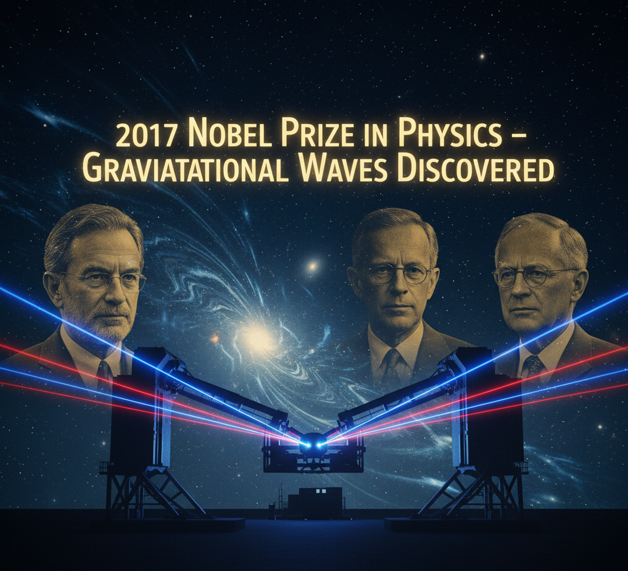
Nobel Prize in Physics 2017 – The First Detection of Gravitational Waves: Listening to the Universe
The year 2017 marked a historic milestone in physics — a moment when one of Einstein’s most daring predictions, made over a century earlier, was finally proven true. The Nobel Prize in Physics 2017 was awarded to Rainer Weiss, Barry C. Barish, and Kip S. Thorne for their decisive contributions to the LIGO detector and the observation of gravitational waves.
This discovery wasn’t just another achievement in astrophysics; it opened an entirely new way to observe the universe — a new “sense” for astronomy, beyond light and radio waves.
Read Also: Nobel Prize in Physics 2016 – Unlocking Hidden Dimensions of Matter through Topology
When and Where Was It Announced?
The 2017 Nobel Prize in Physics was announced on October 3, 2017, by the Royal Swedish Academy of Sciences, Stockholm, Sweden. The official award ceremony took place on December 10, 2017, at the Stockholm Concert Hall, where the medals and diplomas were presented by King Carl XVI Gustaf of Sweden.
Who Won the 2017 Nobel Prize in Physics?

The prize was shared by three scientists who made pivotal contributions to the discovery and detection of gravitational waves through the LIGO experiment:
-
Rainer Weiss – Massachusetts Institute of Technology (MIT), USA
-
Barry C. Barish – California Institute of Technology (Caltech), USA
-
Kip S. Thorne – California Institute of Technology (Caltech), USA
Official Nobel Citation:
“For decisive contributions to the LIGO detector and the observation of gravitational waves.”
What Was the Discovery About?
The 2017 Nobel Prize honored a discovery that confirmed one of Albert Einstein’s final predictions from his General Theory of Relativity (1916) — the existence of gravitational waves.
Gravitational waves are ripples in the fabric of spacetime caused by massive cosmic events, such as colliding black holes or neutron stars. Imagine dropping a stone into a calm pond — the ripples that spread out are like gravitational waves moving through the universe, carrying information about the events that created them.
A 100-Year-Old Prediction Becomes Reality
Einstein’s equations predicted that when massive bodies accelerate (like two orbiting stars), they should send out waves that stretch and compress space itself. But Einstein himself doubted they could ever be detected — because the effect is unimaginably tiny.
Read Also: Nobel Prize in Physics 2015 – The Discovery That Proved Neutrinos Have Mass
It wasn’t until September 14, 2015, that the LIGO (Laser Interferometer Gravitational-Wave Observatory) made the first direct detection of gravitational waves — from two black holes merging 1.3 billion light-years away. That moment changed astronomy forever.
Understanding the Experiment: How LIGO Works
The LIGO detectors are among the most precise instruments ever built. Each observatory consists of two 4-kilometer-long arms arranged in an L-shape, with laser beams bouncing back and forth between mirrors at the ends.
Here’s the basic concept:
-
A powerful laser beam is split into two beams that travel down perpendicular arms.
-
The beams reflect off mirrors and recombine at a detector.
-
If a gravitational wave passes through Earth, it slightly stretches one arm and compresses the other, changing the time the beams take to return.
-
The difference produces an interference pattern, revealing the wave’s passing.
The change in distance measured? ? Less than one-thousandth the diameter of a proton! That’s why the engineering behind LIGO is almost as mind-blowing as the physics itself.
The Collaboration: Science at a Global Scale
The LIGO discovery was not the work of three people alone — it was a monumental collaboration involving over 1,000 scientists from around the world. The Nobel Committee recognized Weiss, Barish, and Thorne for their leadership and vision:
-
Rainer Weiss conceived the original design of the interferometer and its noise-cancellation methods.
-
Kip Thorne, a theoretical physicist, developed the mathematical framework for gravitational waves and predicted what their signals would look like.
-
Barry Barish transformed LIGO from an ambitious idea into a functioning, large-scale scientific project through his leadership and management.
The first detection in 2015 was confirmed by the twin LIGO detectors in Hanford (Washington) and Livingston (Louisiana), ensuring the signal was real and not local noise.
What Did They Actually Detect?
On September 14, 2015, at 09:50:45 UTC, both LIGO detectors simultaneously picked up a faint “chirp” — lasting less than half a second. This chirp was the final collision and merger of two black holes, each around 30 times the mass of the Sun, spiraling into one another and forming a single larger black hole.
The energy released in that fraction of a second was equivalent to 3 solar masses converted entirely into gravitational waves — a power output greater than all the stars in the observable universe combined.
The Significance of the Discovery
This was no ordinary detection. It was the birth of gravitational wave astronomy — a new way to study the universe. Until then, astronomy had been based on light — visible, infrared, X-rays, radio, etc. Gravitational waves provided a completely new sense — like suddenly being able to hear the cosmos.
Through gravitational waves, we can now:
-
Study black holes, which emit no light at all.
-
Understand the dynamics of neutron star mergers.
-
Test Einstein’s general relativity under extreme conditions.
-
Explore the early universe, moments after the Big Bang.
Scientific Depth: Interferometry and Noise Isolation
Detecting gravitational waves required technology far beyond what Einstein imagined.
Key Techniques:
-
Laser Interferometry – Uses interference patterns of light to detect minuscule distance changes.
-
Vibration Isolation – LIGO mirrors are suspended by ultra-pure fused silica fibers to eliminate seismic noise.
-
Vacuum System – The 4 km arms are kept in one of the largest ultra-high vacuum systems in the world.
-
Data Correlation – Signals from both detectors must match perfectly to confirm a genuine gravitational wave.
These advances have since inspired next-generation detectors, including Virgo (Italy), KAGRA (Japan), and LISA (a future space-based mission).
Impact and Legacy
-
Birth of a New Field: Gravitational-wave astronomy now complements traditional telescopes, offering a 3D view of the universe.
-
Technological Spin-offs: Precision laser control, noise isolation, and computational modeling techniques have benefited other fields.
-
Inspiring a Generation: LIGO has become a symbol of global collaboration and scientific persistence — 50 years in the making.
Since 2015, multiple detections have followed — from black hole mergers to neutron star collisions — confirming that the universe is filled with these cosmic symphonies.
About the Laureates
Rainer Weiss
-
Born in 1932, Berlin, Germany (later emigrated to the USA).
-
Professor at MIT.
-
Pioneered the LIGO design and led its early development.
Kip S. Thorne
-
Born in 1940, Logan, Utah, USA.
-
Theoretical physicist, Caltech.
-
Expert on black holes, wormholes, and spacetime; also scientific consultant for Interstellar (2014).
Barry C. Barish
-
Born in 1936, Omaha, Nebraska, USA.
-
Professor Emeritus, Caltech.
-
Project leader who turned LIGO into a functioning, large-scale collaboration.
Prize Details
| Detail | Information |
|---|---|
| Year | 2017 |
| Field | Physics |
| Announced on | October 3, 2017 |
| Announced by | The Royal Swedish Academy of Sciences |
| Presented by | King Carl XVI Gustaf of Sweden |
| Ceremony Date | December 10, 2017 |
| Prize Amount | 9 million SEK (shared) |
| Winners | Rainer Weiss, Barry Barish, Kip Thorne |
| Discovery | Detection of gravitational waves via LIGO |
| Key Significance | Confirmed Einstein’s prediction; opened gravitational-wave astronomy |
FAQs About the 2017 Nobel Prize in Physics
Q1. What exactly are gravitational waves?
They are ripples in spacetime caused by the acceleration of massive objects — like merging black holes or neutron stars.
Q2. How were they detected?
Using the LIGO interferometers, which can measure changes in distance as small as 1/10,000th of a proton’s diameter.
Q3. Why did it take 100 years after Einstein’s prediction to detect them?
Because the signals are incredibly faint, requiring ultra-sensitive instruments that became possible only in the 21st century.
Q4. What was the first detected event called?
GW150914 — named after the date (September 14, 2015) it was observed.
Q5. What’s next after LIGO?
Future observatories like LISA (Laser Interferometer Space Antenna) will detect lower-frequency waves from space, allowing us to study supermassive black holes and early-universe phenomena.
Conclusion
The 2017 Nobel Prize in Physics marked a turning point in human history — the moment we learned to listen to the universe. Thanks to the vision of Weiss, Thorne, and Barish, a century-old prediction came alive, and the cosmos now speaks to us in gravitational whispers.
Their discovery is a triumph of imagination, mathematics, and engineering — proof that even the faintest signals can echo across space and time when humanity dares to listen.
Follow Us:
| Facebook Page | https://www.facebook.com/wavemindedu |
| Instagram Page | https://www.instagram.com/wavemindedu/ |
| Youtube Channel | https://www.youtube.com/@WaveMindEdu |
Website: https://wavemindedu.org/
.png)