Who Won the 2018 Nobel Prize in Physics?
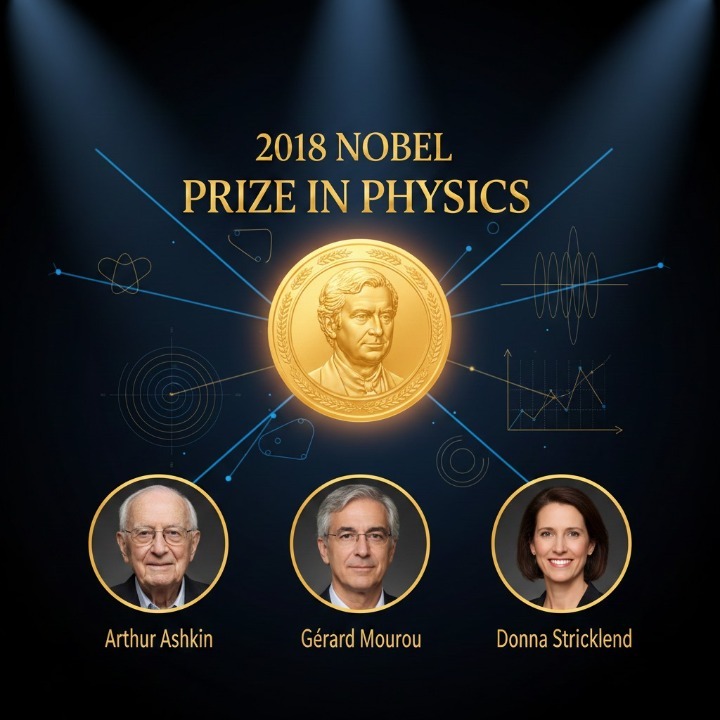
Who Won the 2018 Nobel Prize in Physics?
“For groundbreaking inventions in the field of laser physics.”
The year 2018 marked one of the most remarkable moments in modern physics — a celebration of laser technologies that revolutionized science, medicine, and industry. The Nobel Prize in Physics 2018 was awarded to Arthur Ashkin, Gérard Mourou, and Donna Strickland for pioneering innovations in laser physics that opened new frontiers in research and practical applications.
Read Also: Who Won the 2017 Nobel Prize in Physics?
This Nobel Prize also made history as Donna Strickland became only the third woman ever to win the Nobel Prize in Physics, following Marie Curie (1903) and Maria Goeppert-Mayer (1963).
When and Where Was It Announced?
The 2018 Nobel Prize in Physics was announced on October 2, 2018, by the Royal Swedish Academy of Sciences in Stockholm, Sweden.
The official award ceremony was held on December 10, 2018, at the Stockholm Concert Hall, where the laureates received their medals and diplomas from King Carl XVI Gustaf of Sweden.
Who Won the 2018 Nobel Prize in Physics?
The prize was divided into two parts:
1. Arthur Ashkin (USA) —½ of the Prize
Institution: Bell Laboratories, USA
Contribution: Invention of optical tweezers and their application to biological systems
2. Gérard Mourou (France) — ¼ of the Prize
Institution: École Polytechnique, France & University of Michigan, USA
Contribution: Development of Chirped Pulse Amplification (CPA)
3. Donna Strickland (Canada) — ¼ of the Prize
Institution: University of Waterloo, Canada
Contribution: Co-development of Chirped Pulse Amplification (CPA)
Official Nobel Citation:
“For groundbreaking inventions in the field of laser physics.”

What Were the Discoveries About?
Arthur Ashkin—The Father of Optical Tweezers
Arthur Ashkin invented optical tweezers— a tool that uses laser beams to hold, move, and manipulate microscopic particles like atoms, viruses, and even living cells without touching them.
Read Also: Nobel Prize in Physics 2016 – Unlocking Hidden Dimensions of Matter through Topology
This technique opened revolutionary possibilities in:
-
Biology
-
Biophysics
-
Medical research
-
Nanotechnology
Ashkin’s tweezers even enabled scientists to trap single DNA strands — a major breakthrough in biophysics.

Gérard Mourou & Donna Strickland — Chirped Pulse Amplification (CPA)
Before their work, lasers could not be amplified too much because the intense power would destroy the equipment. Mourou and Strickland solved this by inventing Chirped Pulse Amplification (CPA) in 1985 — a technique that stretches a laser pulse, amplifies it safely, then compresses it back to create an ultrashort, extremely powerful pulse.
CPA became the foundation of today’s high-intensity lasers, used in:
-
Eye surgeries (such as LASIK)
-
Industrial cutting and welding
-
Particle acceleration
-
Fundamental physics research
Donna Strickland’s leadership in this discovery made her one of the most influential women in modern physics.
Understanding the Science
Optical Tweezers: Moving Objects with Light
Optical tweezers work using the momentum of photons:
-
A laser beam is focused into a tiny spot.
-
Small particles are attracted toward the point of highest light intensity.
-
Scientists can move objects by moving the laser.
This allows researchers to:
-
Study bacteria or viruses
-
Pull on DNA molecules
-
Measure molecular forces inside cells
It’s like having microscopic fingers made of light.

Chirped Pulse Amplification: The Laser Revolution
CPA works in three steps:
-
Stretch a short laser pulse
-
Amplify it safely
-
Compress it to get massive energy in a short burst
This technique produces some of the shortest and most intense laser pulses ever created.
Impact and Legacy
Optical Tweezers
-
Allowed manipulation of biological systems at the cellular level
-
Enabled major advances in genetic and molecular research
-
Used in the study of viruses, bacteria, and DNA
Chirped Pulse Amplification
-
Paved the way for ultra-fast laser technology
-
Enabled precise eye surgeries used by millions
-
Sparked progress in laser-based physics and industrial applications
Historical Milestone
-
Donna Strickland became the third female Physics Nobel Laureate
-
The discoveries continue to shape medicine, research, and technology
About the Laureates
Arthur Ashkin
-
Born: 1922, New York, USA
-
Pioneer of optical manipulation
-
His invention opened biophysics to laser tools
Gérard Mourou
-
Born: 1944, Albertville, France
-
Laser physicist specializing in ultrafast lasers
-
Co-founded major research centers in France and USA
Donna Strickland
-
Born: 1959, Guelph, Canada
-
Laser physicist at the University of Waterloo
-
First woman in 55 years to win the Nobel Prize in Physics
Prize Details
| Detail | Information |
|---|---|
| Year | 2018 |
| Field | Physics |
| Announced on | October 2, 2018 |
| Presented by | Royal Swedish Academy of Sciences |
| Ceremony Date | December 10, 2018 |
| Prize Amount | 9 million SEK |
| Winners | Arthur Ashkin, Gérard Mourou, Donna Strickland |
| Discovery | Optical tweezers; Chirped Pulse Amplification |
| Significance | Revolutionized laser physics; impacted medicine & industry |
FAQs About the 2018 Nobel Prize in Physics
Q1. What are optical tweezers?
They are laser-based tools that trap and manipulate microscopic objects like cells and DNA without physical contact.
Q2. What is Chirped Pulse Amplification?
A method to produce extremely powerful, ultrashort laser pulses without damaging the laser system.
Q3. Why was the award historic?
Donna Strickland became the third woman ever to win the Nobel Prize in Physics.
Q4. How are CPA lasers used today?
In eye surgeries (like LASIK), industry, and ultrafast laser research.
Q5. What fields benefit from optical tweezers?
Biology, genetics, medicine, nanotechnology, and materials science.
Conclusion
The 2018 Nobel Prize in Physics celebrated inventions that reshaped the world — from medical laser eye surgery to groundbreaking biological and molecular research.
Arthur Ashkin’s optical tweezers revealed the hidden mechanics of life at the microscopic level, while Mourou and Strickland’s CPA technique unleashed laser power that drives modern science and technology.
Their achievements continue to impact our daily lives and inspire the next generation of physicists, engineers, and innovators.
Follow Us:
| Facebook Page | https://www.facebook.com/wavemindedu |
| Instagram Page | https://www.instagram.com/wavemindedu/ |
| Youtube Channel | https://www.youtube.com/@WaveMindEdu |
Website: https://wavemindedu.org/
.png)